Silicon steel sheet is a silicon‑iron soft magnetic alloy with extremely low carbon content, generally containing 0.5‑4.5 % silicon. Silicon addition increases the electrical resistivity and maximum magnetic permeability of iron, and reduces coercivity, core loss (iron loss) and magnetic aging. It is the key material for iron cores of various transformers, motors and generators. Higher silicon content brings lower iron loss of the material, yet reduces magnetic induction and stamping machinability and increases material hardness. At higher operating frequencies, eddy‑current loss accounts for a larger proportion. Thinner‑gauge silicon steel sheets shall be selected for high‑frequency working conditions. The following are four key performance indicators for silicon steel sheet selection:
Low Iron Loss Iron loss is the most critical quality indicator for silicon steel sheets and the primary parameter concerned by transformer manufacturers. Higher‑grade grades correspond to lower guaranteed iron‑loss values, resulting in lower no‑load core loss and more energy‑saving operation. In the industry, iron‑loss tests are commonly performed with Epstein square rings or standard permeameters (500SST / 1000SST). This test method meets both Chinese national standards and international standards.
High Magnetic Induction Intensity Magnetic induction intensity represents the magnetic conduction capacity of materials. With identical core structures, high‑magnetic‑induction silicon steel enables design with higher magnetic flux density, which shrinks core volume and cuts material costs. It acts as an important indicator for grade selection of main transformers, special transformers and high‑power motors.
Flat Plate Surface and Uniform Thickness Surface quality and thickness tolerance directly affect stacking factor. Uneven plate surfaces and large thickness deviations increase stacking gaps, thus raising no‑load current, noise and additional loss. Material quality can be preliminarily judged intuitively by plate surface texture.
Good Adhesion of Insulating Coating and Weldability The surface insulating film of silicon steel sheets provides inter‑sheet isolation and restrains eddy currents. Coatings with good adhesion deliver strong rust resistance and improve blanking performance. Weldability is also explicitly required for some core structures fixed by welding.
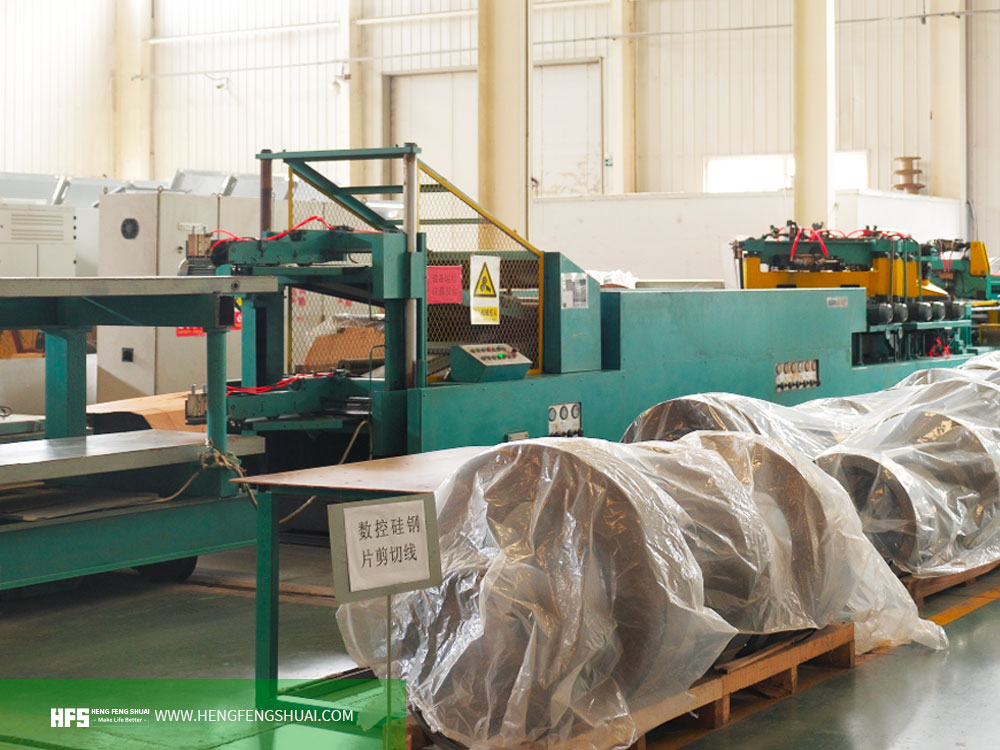
Process Influences on Core Performance
The final performance of finished silicon‑steel‑sheet cores is not merely determined by substrate grades. Stamping and annealing processes exert remarkable influences. For silicon steel of the same grade, different burr sizes after stamping may lead to a performance difference up to 7 % in finished transformers. Comparing silicon steel sheets subjected to nitrogen‑protected stress‑relief annealing against non‑annealed ones, the no‑load loss and no‑load current of finished transformers may differ by 7 %‑10 %. For the same grade on the market, there are bright sheets and black sheets. Black sheets are annealed sheets with superior magnetic properties to ordinary bright sheets. Even for identical grades, actual operating performance varies with core stacking dimensions and joint forms.
Comparison Between Old and New Grades (Domestic Old H‑Series Standards and New National Standard Grades)
Note: The old‑style H‑series designations originated from early Nippon Steel numbering. At present, formal domestic steel mills uniformly adopt the new standard grade systems such as 50W and 30Q.
| Old Designation |
New National Standard Grade |
Equivalent Reference Grade |
Reference Price in 2019 (CNY / ton) |
| H12 |
50H270 |
50WW270 / B50A270 |
21000 |
| H14 |
50H310 |
50WW310 / B50A310 |
15800 |
| H18 |
50H470 |
50WW470 / B50A470 |
14000 |
| H23 |
50H600 |
50WW600 / B50A600 |
12600 |
| H30 |
50H700 |
50WW700 / B50A700 |
11000 |
| H40 |
50H800 |
50WW800 / B50A800 |
9600 |
| H50 |
50H1000 |
50WW1000 / B50A1000 |
8500 |
| H60 |
50H1300 |
50WW1300 / B50A1300 |
8000 |
Remark: The price of annealed sheets is CNY 1000‑2000 per ton higher than the prices listed in the table.
Common Grade Parameter Table for Non‑Grain‑Oriented Silicon Steel
Non‑grain‑oriented silicon steel (H‑series) is mostly applied in iron cores of distribution transformers, motors and reactors. Its magnetic field directions are random with uniform magnetic properties in all directions.
| Parameter Item |
H50 |
H23 |
H18 |
H14 |
H12 |
| Specific Gravity |
7.85 |
7.75 |
7.65 |
7.65 |
7.65 |
| Iron Loss P1.5/50Hz ≤ (W/kg) |
13.0 |
6.2 |
4.7 |
4.0 |
3.6 |
| Magnetic Flux Density B50 ≥ (T) |
1.69 |
1.66 |
1.64 |
1.61 |
1.60 |
Common Grade Parameter Table for Grain‑Oriented Silicon Steel
Z‑series represents cold‑rolled grain‑oriented silicon steel with higher silicon content and excellent magnetic properties along the rolling direction. It is mainly used for iron cores of power main transformers and special transformers.
| Parameter Item |
Z11 |
Z10 |
| Specific Gravity |
7.65 |
7.65 |
| Iron Loss P1.7/50Hz ≤ (W/kg) |
1.66 |
1.51 |
| Magnetic Flux Density B10 ≥ (T) |
1.74 |
1.77 |
Reference of Equivalent Grades for Foreign Steel Mills
Japan JFE (Former Kawasaki)
| Grade |
Thickness |
Iron Loss Range P1.5/50 |
Magnetic Induction B50 |
| 35JN250 |
0.35 mm |
2.18‑2.26 W/kg |
≥1.69 T |
| 50JN270 |
0.50 mm |
2.38‑2.42 W/kg |
≥1.68 T |
| 50JN290 |
0.50 mm |
2.46‑2.51 W/kg |
≥1.68 T |
| 50JN310 |
0.50 mm |
2.50‑2.54 W/kg |
≥1.69 T |
Japan Nippon Steel
| Grade |
Thickness |
Iron Loss Range P1.5/50 |
Magnetic Induction B50 |
| 50H270 |
0.50 mm |
2.37‑2.41 W/kg |
≥1.68 T |
| 50H290 |
0.50 mm |
2.46‑2.50 W/kg |
≥1.68 T |
| 50H310 |
0.50 mm |
2.49‑2.53 W/kg |
≥1.69 T |
China Tai‑yuan Iron and Steel (TISCO)
| Grade |
Thickness |
Iron Loss Range P1.5/50 |
Magnetic Induction B50 |
| 50TW290 |
0.50 mm |
2.54‑2.60 W/kg |
≥1.68 T |
| 50TW310 |
0.50 mm |
2.64‑2.69 W/kg |
≥1.68 T |
| 50TW350 |
0.50 mm |
2.70‑2.76 W/kg |
≥1.69 T |
Detailed Explanation of Grade Naming Rules
1. Chinese Domestic Grade Designation Methods
Cold‑rolled non‑grain‑oriented silicon steel strip (sheet) Old code: DW + iron‑loss value (unit‑weight iron loss × 100 under 50 Hz, 1.5 T) + thickness × 100. Example: DW470‑50: iron loss 4.7 W/kg, thickness 0.5 mm; the new‑style designation is 50W470.
Cold‑rolled grain‑oriented silicon steel strip (sheet) Old code: DQ + iron‑loss value (unit‑weight iron loss × 100 under 50 Hz, 1.7 T) + thickness × 100. Suffix G denotes high‑magnetic‑induction grain‑oriented silicon steel. Example: DQ133‑30: iron loss 1.33 W/kg, thickness 0.3 mm; the new‑style designation is 30Q133.
Hot‑rolled silicon steel sheet Code: DR. Classified into low‑silicon steel (Si ≤ 2.8 %) and high‑silicon steel (Si > 2.8 %) according to silicon content. Format: DR + iron‑loss value + thickness × 100, e.g. DR510‑50. Household‑appliance‑special hot‑rolled thin sheets adopt the prefix JDR, e.g. JDR540‑50.
2. Japanese Grade Designation Methods
Cold‑rolled non‑grain‑oriented silicon steel: Nominal thickness × 100 + A + guaranteed iron‑loss value × 100. Example: 50A470: thickness 0.5 mm, P1.5/50 ≤ 4.7 W/kg.
Cold‑rolled grain‑oriented silicon steel: Nominal thickness × 100 + material code + guaranteed iron‑loss value × 100. G = conventional grain‑oriented; P = high‑magnetic‑induction grain‑oriented. Example: 30G130: thickness 0.3 mm, P1.7/50 ≤ 1.3 W/kg.
Summary
Grain‑oriented silicon steel is preferred for distribution transformers to reduce no‑load loss. Non‑grain‑oriented silicon steel is mostly selected for fans, water pumps and general‑purpose motors. Thin‑gauge silicon steel sheets of 0.35 mm and below are preferred for high‑frequency small‑size special transformers. For grade selection, do not merely focus on grades. Coating type, annealing status and actual measured magnetic properties from mill test certificates shall also be confirmed.
Hengfengshuai Electric supplies oil‑immersed power main transformers, dry‑type transformers, box‑type substations, rectifier / electric‑furnace and other special transformers, as well as complete sets of disconnectors, instrument transformers and switchgears. It provides capacity calculation, short‑circuit‑current checking and complete primary‑scheme solutions for substations.
Email: hunter@hengfengyou.com WhatsApp/Mobile: +8618224429139